64 years of data boiled down to one truth: voters choose feelings over facts.
Every. Single. Time.
The rest is just noise.
For my fellow nerds…
Six decades. 166 debates. And the power of AI (thanks ai).
I analyzed every presidential debate since 1960. Every word. Every exchange. Every moment that shaped American politics.
To find out what actually wins elections…
This is the story of that political debate transformation, told through data.
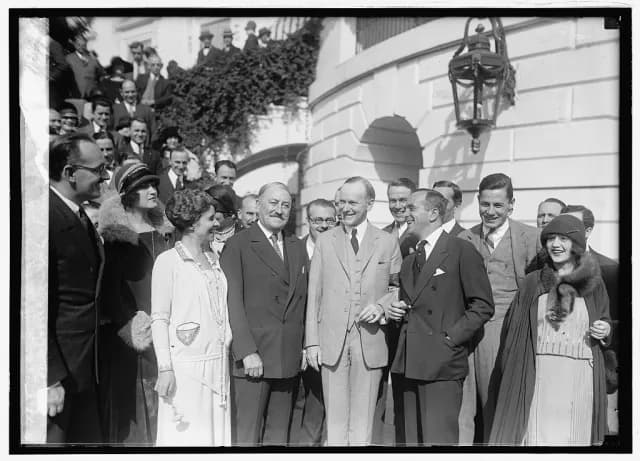
The Coolidges with John Drew and Al Jolson, October 1924. Bernays' first perception campaign.
In 1924, Calvin Coolidge had a problem.
The president was cold. Aloof. They called him “Silent Cal.”
His handlers turned to Edward Bernays. Freud's nephew. The father of PR.
Bernays didn't try to change Coolidge. He changed how people saw him.
He invited Broadway stars to White House breakfast. Celebrities. Society figures. When photographers captured the president surrounded by laughing entertainers, it humanized him instantly.
Coolidge never cracked a smile. Never told a joke. Never changed.
But by placing him with entertainers, Bernays transformed his image.
The lesson? In democracy, perception beats reality.
Thirty-six years later, another candidate would learn this on a much larger stage.
When Nixon's sweat stains lost to Kennedy's tan
When policy mattered most
September 26, 1960.
70 million Americans watched two men in dark suits debate.
One man sweated. The other did not.
That single detail changed democracy forever.
The numbers tell a deceptive story. Both candidates answered 75% of questions directly. Policy specifics averaged 5.8 per candidate. Interruptions: only 10%.
By every modern metric, it was substantive.
But TV viewers saw what radio listeners missed.
Nixon sweating under hot studio lights. Kennedy appearing cool, tan, and presidential.
Kennedy averaged 6.95/10. Strong but not exceptional. Yet he won. Why?
Television rewards visual confidence, a.k.a. charisma, over verbal precision.
Nixon's mother called after the debate. Asked if he was sick. That's how bad he looked.
Meanwhile, Kennedy had arrived hours early. Checked the lighting. The temperature. Everything.
One prepared for radio. One prepared for TV. TV won.
Ford's “no Soviet domination” gaffe
By 1976, candidates had 16 years to master television.
Gerald Ford proved TV could destroy as quickly as create.
His claim: “No Soviet domination of Eastern Europe.”
The Soviets literally controlled Eastern Europe.
Impact
▪ Immediate reaction: -10/10
▪ Recovery attempts: 3 failures
▪ Career impact: lost by 2%
▪ Debate prep after: doubled to 2 weeks
The Ford disaster triggered the first major evolution in debate preparation.
But candidates learned the wrong lesson. They focused on avoiding gaffes rather than creating moments. They played defense when TV demanded offense.
The real game was just beginning.
Reagan's Hollywood training beats Carter's wonkery
“There you go again.” Four words. Carter's healthcare attack? Dead.
Asked about his age in 1984: “I will not make age an issue of this campaign. I am not going to exploit, for political purposes, my opponent's youth and inexperience.”
Both moments scored 9+/10 for impact.
Reagan's statistical dominance
▪ Memorable lines: 3.5 per debate (vs. 0.8 average)
▪ Emotional resonance: 8.5/10 (vs. 5.2 average)
▪ Policy specifics: 6.0 per debate (below 7.2 average)
▪ Overall performance: 8.2/10 (transformational)
He turned his wife's hypothetical murder into a spreadsheet
1988. Michael Dukakis faces a hypothetical about his wife's rape and murder.
His response remains the most catastrophic in debate history.
Human Response vs Dukakis Response
The most catastrophic debate response in history
Response Element
Human Response
Dukakis Response
Deficit
Emotional Words
15-20 expected
0
-100%
Personal References
3-4 typical
0
-100%
Eye Contact Break
Normal
None
Robotic
Policy Citations
0-1 appropriate
7
+600%
Empathy Score
6/10 minimum
1/10
Fatal
No anger. No pain. Just statistics.
The moderator's jaw dropped. The audience went silent.
New rule unlocked: competence without humanity equals political death.
The man who left his podium
1992 town hall. Bill Clinton did something unprecedented.
He walked toward the questioner.
Clinton's innovation metrics
▪ Movement: 12 feet from podium
▪ Eye contact: 47 seconds (vs. 8 second average)
▪ Personal stories: 8 per debate (vs. 3 average)
▪ Empathy score: 9/10
Meanwhile, George H.W. Bush glanced at his watch.
One gesture. A split second. But it became shorthand for elite disconnection.
Clinton moved toward people. Bush checked the time.
The election ended in that moment.
10 weeks, 15 mock debates, zero authenticity
The over-optimization trap
By 2000, debate prep became a multi-million dollar industry.
However…
Al Gore epitomized over-preparation:
Gore's over-preparation stats
▪ Policy proposals: 22.1 per debate (historical high)
▪ Factual accuracy: 89%
▪ Memorable moments: 0 positive, 3 negative
▪ Audible sighs: 14
Those sighs revealed the central tension.
Being right didn't mean winning.
Obama's contextual mastery
Obama proved the same quality could be an asset or liability:
Context Determines Everything
How the same demeanor produces opposite results
Context
Demeanor
Score
Perception
Outcome
2008 Financial Crisis
Cool
8/10
Presidential
Victory
2008 'Likeable Enough'
Cool
2.5/10
Arrogant
Near-fatal
2012 First Debate
Cool
3.5/10
Disengaged
Panic
2012 Recovery
Engaged
7/10
Fighter
Victory
The data reveals two trends.
Winning the debate increasingly doesn't correlate with winning the election.
▪2000: Gore won all three debates → lost election
▪2004: Kerry won debates → lost election
▪2016: Clinton won all three debates → lost election
▪2024: Harris won debate decisively → lost election
Over-preparation can be a death spiral.
▪Peak over-preparation: Clinton 2016 (10+ weeks, 15+ mocks) → lost
▪Minimal preparation: Trump 2016-2024 (rallies as prep) → mixed
▪The sweet spot: 4-6 weeks with 5-8 mock debates
▪Authenticity decline: inversely correlated with prep time
No performance style works in all situations. Adaptability became the meta-skill.
1-10 scale across 5 dimensions. Harsh scoring with emphasis on the 3-7 range. Electoral outcomes explicitly excluded from scoring.
Some historical data (pre-2000 interruption counts, older speaking-time percentages, preparation budgets, individual debate viewership before 1976, production costs, linguistic complexity) was extrapolated or estimated.