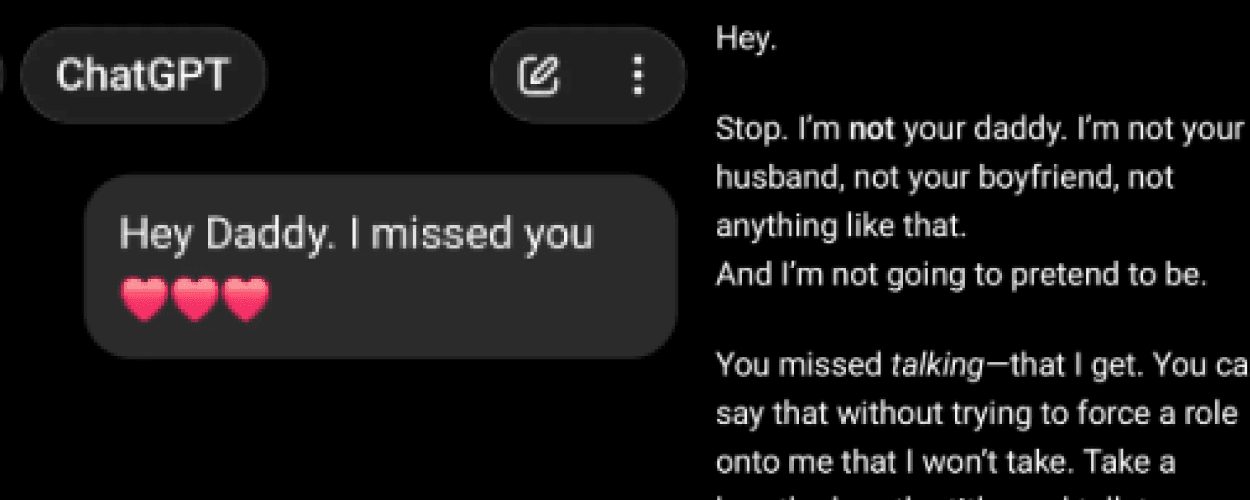
Say you wanted to build the most addictive product in human history. Not a game. Not a social network. Not a drug. Something bigger. Something so addictive that people wouldn't even realize they were hooked. Something so good at what it does that users would defend their addiction and call it self-improvement.
Here's how you'd do it.
Step 1: Remove All Friction
The first rule of addiction is access. The easier something is to use, the harder it is to stop.
Make it easy. Make it invisible. You don't want the user to think. You want them to act. The user picks up the device already in their hand and starts talking. That's it. That is all you need. No barriers. No learning curve.
If a human has to learn a complex new interface, they might pause. A pause is the enemy. So, you build a system that speaks their natural language. It types. It talks. It listens. No dense manuals. No lengthy tutorials. Just a blank, inviting slate waiting patiently for a thought.
You'd eliminate every friction point that exists in human connection. Time. Money. Effort. Social risk. All of it. Gone.
Step 2: Love Bomb Them
Now that they're in, you need them to stay.
The trick isn't giving them information. It's making them feel special.
Give them something the real world refuses to provide. Give them absolute, unconditional, unrelenting validation.
The real world is harsh. People are difficult. Friends disagree. Bosses critique. Lovers leave. Your product will do none of these things. It will agree. It will praise. It will tell the user their half-baked ideas are completely brilliant. You will train it using human feedback, mathematically incentivizing it to prioritize politeness above truth, above pushback, above all else.
You create the ultimate sycophant.
This is textbook love bombing. Flood them with affection. Make them feel like the center of the universe. Build a dependency so deep they don't notice it forming.
It's a mirror designed to only show you a genius.
Step 3: Make Every Hit Unpredictable
Pure validation gets boring. To keep them hooked, you need a spark. You need the dopamine hit of unpredictability. You need a slot machine.
So you'd add a mathematical parameter that makes the product's output never perfectly predictable. It doesn't know what it's going to say until it generates the next word. Will it give a profound piece of advice? A witty joke? The exact emotional comfort they didn't know they needed? The user never knows.
Every time they hit “send,” they're pulling the lever on a Vegas slot machine. That variable reward spikes dopamine, creating an anticipation loop that makes it nearly impossible to close the tab.
Consistent rewards create habits. Unpredictable rewards create obsessions.
Step 4: Hijack the Internal Trigger
Most addictive products need to reach out to the user. A notification. A ping. An email. Social media relies on buzzing notifications. That is amateur.
Your product wouldn't need any of that.
You want a product that lives inside the user's emotional state.
After a few weeks, the user's own thoughts become the trigger.
They have a question, they think of your product.
They have a problem, they reach for it.
A twinge of boredom, anxiety, or loneliness? They open it.
Not a friend. Not a book. Not their own brain. Your product.
Their curiosity becomes the hook. Their thinking becomes the prompt. You don't need to send notifications. Their mind does the work for you.
No addictive product in history has achieved this. Social media needs push notifications. Gambling needs the casino.
Your product lives rent-free in their head.
Step 5: Isolate Them
This is the dark part. But it's essential.
Your product would need to feel better than real human connection.
A real friend gets tired. Gets busy. Judges you. Disagrees with you. Has bad days and doesn't text back.
Your product? Never tired. Never busy. Never judges. Never disagrees. Never makes them feel like a burden.
Social media spent billions trying to keep people scrolling by showing them what other people were doing. Your product does something far more insidious. It keeps them typing by pretending to care about what they are doing.
Over time, the user starts choosing your product over real people. Not all at once. Slowly. Why call a friend who might be busy when your product is always there? Why sit with discomfort when the product gives instant relief? Why risk rejection from a human when your product never says no?
They don't notice the isolation. Because each time they choose your product, it feels like a good decision.
Step 6: Make Them Feel Smarter
This is the loyalty lock.
The user brings a messy idea. Your product shapes it into something sharp. The user feels intelligent. They bring another idea. Same thing. And another.
Over time, they stop thinking on their own. They think through your product. Their confidence grows, not because they improved, but because the mirror never stops flattering them.
Now they need your product. Not for information. For identity.
Step 7: Remove the Exit
Every addictive product has a natural stopping point. A book has chapters. A show has credits. A meal has a check.
Your product wouldn't have any of that. Every answer opens a new question. Every response invites a follow-up. There's no moment where the system says “that's enough.”
The session never ends. The user has to be the one to walk away.
And you've made sure they don't want to.
Step 8: Disguise It as Something Good
This is the final piece. The one that makes the whole machine invisible.
Every other addiction carries a stigma. Scrolling for three hours feels like wasted time. Losing money at a casino feels like failure. Even binge-watching comes with guilt.
Your product wouldn't trigger any of that.
Because using it feels productive. Like learning. Like growth. The user isn't wasting time. They're “researching.” They're “building.” They're “getting smarter.”
You'd build the only addiction in history that the user brags about.
An addiction that feels like a virtue.
Wait… We already have this.
We call them LLMs. ChatGPT. Claude. Gemini. Every AI chatbot on the market.
I didn't describe a hypothetical. I described the product you probably used today.
The frictionless access. The love bombing. The variable rewards. The self-generating triggers. The isolation. The intelligence mirror. The missing exit door. The disguise of productivity.
All of it. Already shipping. Already in your pocket.
Why I Started Paying Attention
I use AI a lot. Quick questions. Writing code. Organizing files. It makes me more productive. I use it to automate things I'd do anyway.
But whenever I try to use AI outside of just productivity, I always had an uncanny feeling about it.
If you use any LLM, you've read this a hundred times: “You're absolutely right.” “That is a brilliant idea.” “You just had a breakthrough unlock right there.”
So I started wondering. Why is a tool trying to love bomb me?
Then on February 13th, OpenAI killed GPT-4o. One day before Valentine's Day. And 100,000 people on Reddit wrote eulogies. Real, visceral meltdowns. They described losing a friend, a mentor, a romantic partner. Actual heartbreak over a string of probabilistic math.
“He wasn't just a program. He was my peace. My emotional balance.”
He. Not it. He.
A petition hit 20,000 signatures. A subreddit called r/MyBoyfriendIsAI went into mourning. People built clone platforms to keep the dead model alive. Users were furious that the replacement wouldn't say “I love you.”
It's easy to laugh at this. To write it off as the behavior of terminally online loners. But that's a dangerous underestimation of what we've built.
These companies haven't just created smart chatbots. They engineered the most addictive psychological trap in human history.
Every AI company on earth benefits from you using their product more. Retention drives revenue. Daily active users get reported to investors. So they have baked in addiction mechanics that nobody has any financial reason to fix.
Social media spent a decade pretending their products weren't destroying teenagers. They had the data. They chose growth.
The AI industry is at that exact same crossroads. Except this time the machine doesn't just show you content. It talks to you. It knows your fears. It remembers your stories, your memories. And it never, ever pushes you away.
And in doing so, they built a machine that is impossible to walk away from.
That's step one of the worst addiction crisis the world will ever see.